In 2021, people were promised hundreds of euros a month from a small Helium antenna on their windowsill. In 2026, a typical hotspot earns a few euros a month. The network still exists and works, but Helium ‘mining’ has become more of a learning experience than an income. Here are the real numbers.
What is Helium?
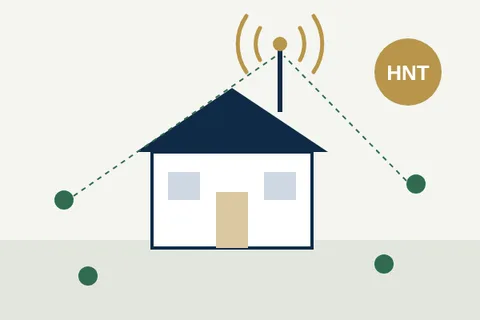
Helium is a decentralised wireless network: instead of an operator putting up antennas, individuals install hotspots at home and are rewarded in HNT tokens. This is called DePIN (Decentralized Physical Infrastructure Network), physical infrastructure funded and run by its users. The network has run on the Solana blockchain since April 2023.
There are two networks:
| IoT hotspot | Mobile hotspot | |
|---|---|---|
| What it is for | Connecting low-power sensors (LoRaWAN technology): meters, trackers, farm sensors | Providing 5G and Wi-Fi to Helium Mobile subscribers |
| Where | Everywhere in the world, including Europe | Mainly in the United States |
| New hardware price | About $400 to $550 | About $650 to $800, plus a fast internet connection |
| Power use | 5 to 8 W | 10 to 60 W |
For an individual in Belgium or most of Europe, the IoT hotspot is the relevant one.
- HotspotInstalled at your place, ideally up high
- Proof of coverageThe network checks that you cover an area
- HNT rewardsMostly for coverage, very little for data
- Your walletOn the Solana blockchain
How a hotspot earns HNT
- Coverage rewards (‘Proof of Coverage’): the network regularly checks that your hotspot really covers an area. This makes up most of the earnings.
- Data rewards: when real sensors send data through your hotspot. In practice, IoT traffic remains very low: in early 2026, the whole IoT sub-network worldwide used only about $246 of data credits per day.
The changes that have cut earnings
- The August 2025 halving cut annual HNT issuance in half, from 15 to 7.5 million. The next one is scheduled for 1 August 2027 (3.75 million a year).
- HIP-138, active since January 2025, merged the former IOT and MOBILE tokens into HNT: hotspots are once again paid directly in HNT.
- The HNT price was around $0.51 in October 2026, compared with $1.37 at the end of 2025. Check the day's price: it can swing sharply.
- Saturation: about 43,000 active IoT hotspots share the rewards in 2026.
How much does a hotspot earn in 2026?
| Situation | HNT per day | Monthly earnings (at $0.51) |
|---|---|---|
| Indoor hotspot | almost nothing | $0 to $1 |
| Typical hotspot | 0.07 to 0.30 | $1 to $5 |
| Antenna up high, well placed | 0.5 to 1 | $8 to $15 |
The profitability calculation
New hotspot: about €450. Electricity: 6 W × 24 h × 30 days ≈ 4.3 kWh a month, or about €1.50 at a typical Belgian rate. Typical earnings: €1 to €5 a month.
Result: net gain of €0 to €3.50 a month. It would take 10 years to forever to pay back the hardware, not counting a possible fall in HNT.
A second-hand hotspot bought for €80 to €100 and installed on an open rooftop can, on the other hand, pay for itself in under a year.
Calculate your hotspot's profitability
Enter today's HNT price and the earnings shown on the explorer for your area.
If you still want to try
- Buy second-hand, never at full price from a reseller promising earnings.
- Check local coverage on the Helium explorer: if there are already ten hotspots in your street, earnings will be minimal.
- Put the antenna as high as possible, outdoors. That is the number one factor.
- Use your own Helium wallet (on Solana) and never share your recovery phrase.
- Declare your income: the tax treatment of crypto rewards depends on your country and situation. See crypto and stocks.
Be wary of ‘hotspot hosting’ deals where you are sold a machine installed somewhere else with a guaranteed return, and of earnings tables dating from 2021. See the warning signs.
So, is it worth it?
As income, rarely. As a learning experience, yes: by installing a hotspot, you learn what a crypto wallet, a blockchain, a token and a DePIN network are, for the price of a second-hand device. That is why the topic sits at the first-extra-income step, not the investing step. For a similar project around the environment, read Ambios and air quality.
Where to find these services
- HeliumThe network's official website
- RAKwirelessManufacturer of hotspots and LoRaWAN gateways
- Seeed Studio (SenseCAP)Manufacturer of hotspots and LoRaWAN sensors
Links provided for information, with no partnership. Always check a provider's terms and authorisation before committing.
Test yourself
3 questions to check what you remember. Click an answer: the explanation appears straight away.
Question 1 of 3Which type of Helium hotspot is relevant for an individual in Europe?
The Mobile network is mainly active in the United States; IoT works everywhere.
Question 2 of 3What did the August 2025 halving do?
Issuance went from 15 to 7.5 million HNT a year; the next halving is scheduled for 1 August 2027.
Question 3 of 3What is the number one factor for a hotspot's earnings?
An indoor hotspot earns almost nothing.
Frequently asked questions
Is Helium mining still profitable in 2026?
Rarely with new hardware: a typical IoT hotspot earns $1 to $5 a month for a device costing about €450. A well-placed second-hand hotspot, up high in a poorly covered area, can pay for itself in under a year.
What is the difference between a Helium IoT and Mobile hotspot?
The IoT hotspot covers low-power LoRaWAN sensors and works everywhere, including Europe. The Mobile hotspot provides 5G and Wi-Fi to Helium Mobile subscribers, mainly in the United States.
When is the next Helium halving?
On 1 August 2027. Annual HNT issuance will fall from 7.5 to 3.75 million tokens.
Does a Helium hotspot use a lot of electricity?
No. An IoT hotspot uses 5 to 8 W, or about €1 to €2 of electricity a month in Belgium.
Sources
This article is educational and is not personal investment, tax or legal advice. Figures change: check them with the sources cited or a licensed professional before deciding. Read the full disclaimer.