Published in 1997, ‘Rich Dad Poor Dad’ has sold nearly 40 million copies. For many people, it is the book that started it all. Its basic ideas are still valuable, but its author also carries some baggage that is worth knowing about before you follow his advice to the letter.
Who is Robert Kiyosaki?
Robert Kiyosaki is an American author and entrepreneur born in Hawaii. His book recounts the financial education he says he received from two father figures: his biological father, a highly educated teacher who was always short of money (the ‘poor dad’), and a friend's father, an entrepreneur without a degree but rich (the ‘rich dad’). He then expanded this brand into books, seminars and games, including the famous Cashflow game.
Lesson 1: an asset puts money in your pocket
This is the most useful idea in the book, and it fits in one sentence:
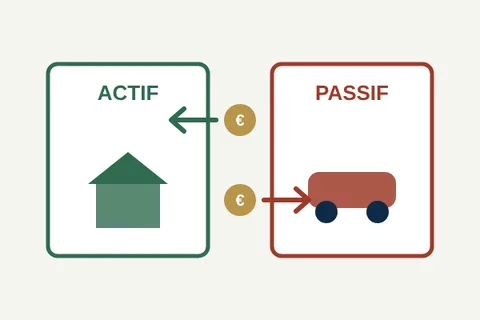
An asset puts money in your pocket. A liability takes money out.
By this definition, the home you live in is not an asset: it costs you every month (mortgage, property tax, upkeep). A rented flat that brings in more than it costs is one. This is not the accountants' definition, but it forces you to look at what matters for financial freedom: monthly cash flow.
Exercise
List your ten largest possessions. For each one, note whether it earns you money or costs you money every month. Many people discover they have almost no assets in Kiyosaki's sense.
Exercise: asset or liability?
Using Kiyosaki's definition: an asset puts money in your pocket every month, a liability takes money out.
- Your own car
Insurance, fuel, maintenance, depreciation: it costs you every month.
- A studio rented for €600 that costs €450 a month all in
It leaves €150 a month: it is an asset.
- The house you live in, with its mortgage
In Kiyosaki's sense, it costs you every month. It remains useful and may gain value, but it does not pay your bills.
- Shares in an ETF that pays dividends
The dividends go into your pocket.
- A €120-a-month ‘club’ membership you don't use
Money going out with nothing coming back: a liability.
- A second-hand Helium hotspot that earns more than its electricity costs
Small, but it brings in more than it costs every month.
Lesson 2: the rich buy assets, the middle class buys liabilities
When their salary goes up, most people raise their standard of living: a more expensive car, a bigger house, longer loans. Kiyosaki calls this the rat race. The way out is to direct every rise in income towards assets, until the income from those assets exceeds your expenses.
Lesson 3: the cashflow quadrant
In a later book, Kiyosaki classifies people by how they earn their money:
| Quadrant | Who | Source of income |
|---|---|---|
| E (employee) | Salaried worker | Their time, for an employer |
| S (self-employed) | Freelancer, professional | Their time, for themselves |
| B (business owner) | Business owner with a team | A system that runs without them |
| I (investor) | Investor | Their money working |
The message: move gradually from the left-hand quadrants (E, S) to the right-hand ones (B, I). Buying a business and rental property are two classic ways in.
Lesson 4: financial education is not taught at school
Kiyosaki insists: nobody teaches us to read a balance sheet, negotiate a loan or understand tax. That is true, and it is one of the reasons this site exists.
The criticisms to know about
Reading Kiyosaki critically takes nothing away from his good ideas. Here is what public sources report:
- Little concrete advice. Critics say the book relies on anecdotes, with no quantified method.
- Controversial seminars. In 2010, CBC's Marketplace programme (Canada) investigated ‘Rich Dad’ seminars where investments presented as successes turned out to be empty lots. Participants also brought a class action.
- A corporate bankruptcy. In 2012, his company Rich Global LLC filed for bankruptcy after being ordered to pay about $23.7 million to The Learning Annex, a seminar organiser.
- Unfortunate timing. His seminars were promoting US real estate in 2006 and 2007, just before the crash.
The ‘free talk, then a training course costing several thousand euros’ model is common in this world. It is not illegal, but always ask about the total price before committing, and let 48 hours pass before signing.
What to keep
- Distinguish assets from liabilities by monthly cash flow.
- Do not raise your standard of living with every pay rise.
- Aim for income that does not depend on your time.
- Keep learning, including through games.
And what to leave behind: the idea that daring is enough, or that degrees and saving are useless.
Where to find these services
- Rich DadRobert Kiyosaki's company: books, games and courses
Links provided for information, with no partnership. Always check a provider's terms and authorisation before committing.
Test yourself
4 questions to check what you remember. Click an answer: the explanation appears straight away.
Question 1 of 4According to Kiyosaki, what is an asset?
It is a definition centred on cash flow, different from the accountants' one.
Question 2 of 4What is the ‘rat race’?
Every pay rise is absorbed by new spending, and you stay dependent on your salary.
Question 3 of 4In the cashflow quadrant, which profiles have income that does not depend on their time?
The business owner (B) and the investor (I) earn thanks to a system or their capital.
Question 4 of 4What criticism was made of the ‘Rich Dad’ seminars?
CBC's Marketplace programme investigated these seminars in Canada in 2010.
Frequently asked questions
Is ‘Rich Dad Poor Dad’ still worth reading?
Yes, for its definition of assets and liabilities and for the wake-up call it gives. Complement it with more practical books on investing and on your own country's tax system.
Did the rich dad exist?
His identity has never been independently confirmed. Some link him to a Hawaiian businessman; other critics doubt he existed as the book describes him. That does not change the value of the ideas, but it is a reminder that this is a story, not a verifiable biography.
What is the rat race?
The cycle of work, salary, spending, in which every rise in income is absorbed by a higher standard of living. You get out when your passive income exceeds your expenses.
Sources
This article is educational and is not personal investment, tax or legal advice. Figures change: check them with the sources cited or a licensed professional before deciding. Read the full disclaimer.