Buy a property below its value, renovate it and sell it for more: on paper, flipping is simple. In Belgium, between 12 to 12.5% registration duties, notary fees and tax on the capital gain, the margin melts away fast. Here is how to do the calculation honestly before signing.
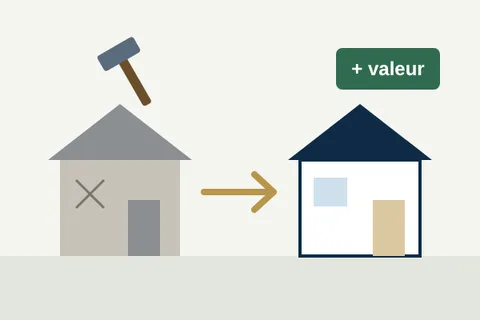
The principle
Flipping creates value in three ways:
- Buying below market price: inheritance, urgent sale, a poorly presented property, defects that put other buyers off.
- Transforming: renovation, better energy performance, reorganising the rooms.
- Splitting or changing use: a large house turned into several flats, a shop into a home, with the necessary permits.
Unlike buy to let, this is not passive income: it is an activity, with a one-off gain. It is often used to build capital quickly, which is then invested in rental properties.
- Find the discountInheritance, urgent sale, visible defects
- Cost it outWorks, contingencies, holding costs, resale
- BuyAt the calculated maximum price, not the asking price
- RenovateOn time and on budget
- ResellAt the cautious target price
The calculation that decides everything
Example: a house to renovate
| Purchase price | €150,000 |
| Purchase costs (about 15% in Wallonia for an investment property) | €22,500 |
| Works | €60,000 |
| Contingency (15% of works) | €9,000 |
| Holding costs: interest, insurance, energy, property tax over 10 months | €7,000 |
| Resale costs: agent, EPC, certificates | €8,000 |
| Total cost | €256,500 |
| Resale price | €290,000 |
| Margin before tax | €33,500 |
The margin is about 13% of the total cost, for nearly a year of work and risk. If works overrun by 20% (€12,000) or the resale price falls by 5% (€14,500), it loses more than a third. If both happen, only €7,000 remains, before tax.
Calculate the maximum purchase price starting from a cautious resale price, minus all costs, minus the margin you require. That figure, not the asking price, guides your offer.
Simulate your project
Test a works overrun or a lower resale price: the margin reacts very quickly.
Capital gains tax
In Belgium, for an individual:
- the gain on a built property resold within 5 years of purchase is taxed at 16.5%, unless it is your own home;
- for undeveloped land, it is 33% within 5 years and 16.5% between 5 and 8 years;
- if the tax authorities consider the transaction speculative, the rate rises to 33%;
- if you carry out so many transactions that you are effectively a professional property dealer, gains are taxed at progressive rates, with social contributions.
The calculation of the gain takes into account a flat-rate allowance for purchase costs and works carried out by registered contractors: keep all your invoices. Many regular investors end up operating through a company: that decision should be made with an accountant, not on a forum. Other countries tax property flipping very differently, so check your local rules.
Essential skills
- Estimating a resale price from actual sales in the area, not from listings.
- Costing works: bring a contractor or an architect on your first viewings.
- Knowing planning rules: a refused permit can destroy the whole profitability of a split.
- Negotiating on the purchase, with contractors and on the sale.
- Managing a building site: deadlines, coordinating trades, handover.
The risks
- Works overruns, the number one risk.
- A market downturn during the works.
- Hidden problems: damp, structural issues, asbestos, non-compliant wiring.
- An unsellable property: bridging finance running while the property does not sell.
Le Club, founded by Mahery Razafindrazaka, who has made flipping one of his specialities, offers a dedicated programme: see our presentation of Le Club.
Where to find these services
- BidditBelgian notaries' online public auctions: a source of below-market properties
- ImmowebTo compare with the prices of renovated properties
- Notaire.be / Notaris.beCapital gains tax and purchase costs in Belgium
Links provided for information, with no partnership. Always check a provider's terms and authorisation before committing.
Test yourself
3 questions to check what you remember. Click an answer: the explanation appears straight away.
Question 1 of 3How do you set your maximum purchase price?
This reverse calculation, not the advertised price, guides an offer.
Question 2 of 3A Belgian individual resells a built property three years after buying it. How is the gain taxed in principle?
The 16.5% tax applies to built properties resold within 5 years, other than your own home.
Question 3 of 3What is the number one risk in flipping?
A 20% works overrun can cost more than a third of the margin.
Frequently asked questions
Is property flipping profitable in Belgium?
It can be, but purchase costs of about 15%, the cost of works and tax on the gain sharply reduce the margin. A successful project often yields 10 to 20% of the total cost before tax, and a works overrun can wipe it out.
How is the gain on a flip taxed in Belgium?
For a built property resold within 5 years by an individual, the gain is taxed at 16.5%. It can be taxed at 33% if the transaction is deemed speculative, and at progressive rates if it is a professional activity.
Should you set up a company to flip properties?
Not for a first project. For a regular activity, a company may make sense: the decision depends on your situation and should be made with an accountant.
Sources
This article is educational and is not personal investment, tax or legal advice. Figures change: check them with the sources cited or a licensed professional before deciding. Read the full disclaimer.