Psychologist Daniel Kahneman won the Nobel Prize in Economics in 2002 for showing that our financial decisions are far from rational. We see trends where there is only chance, we avoid losses more than we seek gains, and we overestimate our skills. Knowing these biases does not make them go away, but it lets you put guardrails in place.
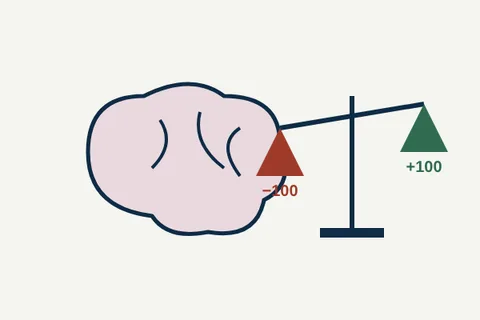
Loss aversion
Losing €100 hurts about twice as much as winning €100 feels good. Typical consequences:
- you hold on to a losing investment for too long, waiting to ‘win it back’;
- you sell a winning investment too early, to ‘lock it in’;
- you panic and sell everything during a temporary fall.
The antidote: decide on written rules in advance (amount invested each month, target allocation) and do not look at your investments every day.
Fear of missing out (FOMO)
When everyone is talking about a crypto, a stock or a ‘great deal’, you are afraid of being the only one not to benefit. Enthusiasm is often strongest at the top. Scammers know this and exploit it with ‘limited-time’ offers.
The antidote: the 48-hour rule. If the opportunity is real, it will still be there in two days.
Overconfidence
Most drivers think they drive better than average, and most investors think they beat the market. A few gains in a rising market reinforce this illusion. Yet studies show that individuals who buy and sell often get worse results on average, largely because of fees and badly chosen moments.
The antidote: honestly compare your results with a simple global ETF over several years.
Confirmation bias
Once a decision is made, we look for information that confirms it and ignore what contradicts it. This is especially visible in online communities around a crypto or a sales network.
The antidote: deliberately look for the best arguments against your idea, for example by typing the name of the investment followed by ‘scam’ or ‘review’.
Anchoring
The first number we see becomes the reference: the purchase price of a stock, the asking price of a house, a platform's ‘returns up to 12%’. We then judge everything against that number, even if it is irrelevant.
The antidote: start from your own calculations, such as the net yield or maximum purchase price methods.
Herd behaviour
Doing what others do is reassuring. Useful in everyday life, dangerous in investing: bubbles form when everyone buys, crashes when everyone sells.
Mental accounting
We treat money differently depending on where it comes from: a bonus or a crypto gain feels ‘free’ and is spent or risked more easily than a salary. Yet a euro is still a euro.
Putting guardrails in place
- A written plan: goal, monthly amount, allocation. Reread it before any decision.
- Automation: scheduled payments spare you from choosing ‘the right moment’.
- A decision journal: why I am buying, at what price, what would make me change my mind.
- An outside view: a sceptical friend or a mastermind group.
My guardrails against my own biases
Tick the ones you already have in place.
Where to find these services
- Wikifin (FSMA)Financial education from the Belgian regulator (French and Dutch)
Links provided for information, with no partnership. Always check a provider's terms and authorisation before committing.
Test yourself
3 questions to check what you remember. Click an answer: the explanation appears straight away.
Question 1 of 3What is loss aversion?
It pushes you to hold losers too long and sell winners too early.
Question 2 of 3Everyone is talking about a crypto that tripled in a month. Which bias is lurking?
Collective enthusiasm is often at its peak near a top.
Question 3 of 3What is the antidote to confirmation bias?
Typing the name of an investment followed by ‘review’ or ‘scam’ is a good habit.
Frequently asked questions
What is loss aversion?
The tendency to feel a loss about twice as strongly as a gain of the same amount. It pushes you to hold losing investments too long and sell winners too early.
What does FOMO mean in investing?
Fear of missing out on an opportunity. It pushes you to buy when enthusiasm is highest, often near a top.
How do you protect yourself from your own biases?
With a written plan, automatic payments, a decision journal, the 48-hour rule and the opinion of someone outside.
Sources
This article is educational and is not personal investment, tax or legal advice. Figures change: check them with the sources cited or a licensed professional before deciding. Read the full disclaimer.