No investment strategy holds up without two foundations: knowing where your money goes each month, and having a cushion for hard times. It is not the most exciting topic on the journey, but it is what separates those who move forward from those who start again from zero at every surprise.
Step 1: know where your money goes
Observe before you set rules. Take your statements from the last three months and sort each expense into four categories:
- Fixed costs: rent or mortgage, energy, insurance, subscriptions.
- Everyday spending: food, transport, health.
- Treats: going out, restaurants, travel, non-essential purchases.
- Saving and investing.
Banking apps often categorise spending automatically. A simple spreadsheet works too. What matters is the result: most people discover forgotten subscriptions and ‘small’ expenses that add up to several hundred euros a month.
Step 2: the 50/30/20 rule
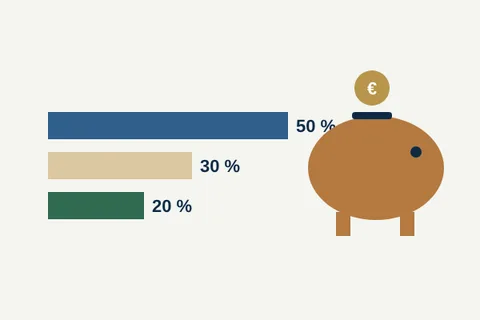
Popularised by US senator Elizabeth Warren, the 50/30/20 rule gives a simple starting point for splitting your net income:
- 50% for needs: housing, energy, food, transport, insurance.
- 30% for wants: leisure, restaurants, travel.
- 20% for saving and investing, including paying off expensive debt early.
It is not a law. In cities, housing alone sometimes takes more than 40% of income. What matters is the last figure: a savings rate of 20% or more moves you much faster towards financial freedom.
Your 50/30/20 budget and emergency fund
Enter your amounts: the tool splits your income and calculates the cushion to build.
Variant: the 6 jars method
Popularised by T. Harv Eker in Secrets of the Millionaire Mind (2005), the author behind the Millionaire Mind seminar, this method splits each net income, as soon as it arrives, between six 'jars': six separate accounts or sub-accounts, fed by standing orders on payday.
| Jar | Share | What it is for |
|---|---|---|
| Necessities | 55% | Housing, energy, food, transport, insurance |
| Financial freedom | 10% | Invested to produce passive income. You never spend it: only its returns, once you are free |
| Long-term savings | 10% | Planned big expenses (car, renovations, holidays) and, at first, the emergency fund |
| Education | 10% | Books, courses, training: investing in your skills |
| Play | 10% | To spend every month without guilt, so you stick with the method |
| Give | 5% | Charities, helping people close to you |
What it adds to the 50/30/20 rule: the same savings rate of about 20%, but visible and split by purpose. Money meant for investing is no longer mixed with holiday money, and the Play jar avoids the 'diet too strict' effect that makes people give up after three months.
Its limits: 55% for necessities is tight for a household renting in a city. Adapt the percentages to your situation; what matters is keeping the Financial freedom jar and filling it first (see the next step). And the Education jar should not become an excuse to buy expensive coaching on impulse: see how to choose a seminar.
Your 6 jars
Enter your net income: the tool splits it and shows what the Financial freedom jar can grow into.
Step 3: pay yourself first
Most people save what is left at the end of the month, which is often nothing. Reverse the order: set up an automatic transfer to a savings or investment account on the day your salary arrives. Then spend what is left freely.
Increase that transfer with every pay rise, before you have time to get used to the new income. It is the most effective defence against the ‘rat race’ described by Robert Kiyosaki.
- Salary receivedThe automatic transfer goes out the same day
- SavingsEmergency fund first, investing next
- Fixed costsRent, energy, insurance
- The restYou spend it freely
Step 4: build the emergency fund
The emergency fund is money available immediately for the unexpected: a car breakdown, a boiler, job loss, illness. Without it, the first hard knock forces you to borrow at a high rate or to sell your investments at the wrong moment.
How much?
- 3 months of expenses if you are an employee with a stable job in a two-income household.
- 6 months or more if you are self-employed, the only earner, or own a rental property.
Where to keep it?
In a savings account separate from your current account, accessible within a day or two. Not in the stock market, not in crypto: its job is not to earn, but to be there when needed. In Belgium, interest on regulated savings accounts is tax-free up to an annual threshold; many countries have similar tax-free savings schemes.
Give the account a name, such as ‘Peace of mind’. It becomes harder to dip into it for a holiday.
Step 5: deal with debt
High-interest debt (consumer loans, overdrafts, credit cards) comes before investing. Paying off a 10% debt is the same as a guaranteed 10% investment. The starter guide explains the ‘avalanche’ and ‘snowball’ methods.
What next?
Once the emergency fund is built and expensive debts are paid off, the automatic transfer can go towards investing: ETFs and stocks, listed real estate or pension savings. That is when money starts working for you.
Where to find these services
- Wikifin (FSMA)Budgeting tools and neutral advice from the Belgian regulator (French and Dutch)
Links provided for information, with no partnership. Always check a provider's terms and authorisation before committing.
Test yourself
3 questions to check what you remember. Click an answer: the explanation appears straight away.
Question 1 of 3What does the 50/30/20 rule suggest?
It is an indicative split of net income, popularised by Elizabeth Warren.
Question 2 of 3How much should a self-employed person aim for in their emergency fund?
A self-employed person has no guaranteed salary: a larger cushion protects them in case of illness or a slowdown in business.
Question 3 of 3Where should you keep your emergency fund?
Its job is to be available and stable, not to earn.
Frequently asked questions
How much should you have in your emergency fund?
Usually three months of expenses for an employee with a stable job, and six months or more for a self-employed person, a single-income household or a landlord.
What is the 50/30/20 rule?
An indicative split of net income: 50% for needs, 30% for wants, 20% for saving and investing.
Should you invest your emergency fund?
No. It must stay available and stable, in a separate savings account. Its job is to stop you having to sell your investments at the wrong moment.
What is the 6 jars method?
A budgeting method popularised by T. Harv Eker: each net income is split on arrival between six accounts, 55% for necessities, 10% for financial freedom, 10% for long-term savings, 10% for education, 10% for play and 5% for giving. The percentages can be adapted to your situation.
Sources
This article is educational and is not personal investment, tax or legal advice. Figures change: check them with the sources cited or a licensed professional before deciding. Read the full disclaimer.